Becoming an Intercultural Church: It Begins on Monday
By Rev. Dr. Stephen Moon, Pastor and Missional Leader, Intercultural Mosaics
Many of our Presbyterian churches are asking a good question: how can we become more diverse and intercultural? I hear it often, and I’m thankful for it.
But I think we sometimes start in the wrong place. We talk about worship style, multicultural music, a cultural festival, or calling a pastor from a different background. All of that can be good. None of it will make a church intercultural by itself.
A church becomes intercultural when its people begin to live that way Monday through Saturday. So the first question is a personal one. Who is part of my everyday life? Who do I eat with? Whose stories do I listen to? Who have I welcomed, and I mean into my life, not only into my church?
God’s Mission Has Always Crossed Boundaries
This isn’t a new idea. God told Abraham, “all peoples on earth will be blessed through you” (Genesis 12:3). Isaiah called God’s house “a house of prayer for all nations” (Isaiah 56:7). And John saw “a great multitude that no one could count, from every nation, tribe, people and language” (Revelation 7:9). When I read these together, I can’t treat becoming an intercultural church as a program or a strategy. It is joining in the mission of God.
One of my favorite stories is Ruth. She was a Moabite, a foreigner in Israel, and she said to Naomi, “Your people will be my people and your God my God” (Ruth 1:16). Nobody welcomed Ruth through a diversity program. She became part of a family. She shared a life with them, and in the end this foreign woman is named in the family line of King David, and of Jesus.
I think it changes how we see the people around us. They are not only people we need to reach. God may already be writing a story with them. So instead of asking how we can get them to come to our church, we can ask how we can be good neighbors.
Saturdays at Mosaics
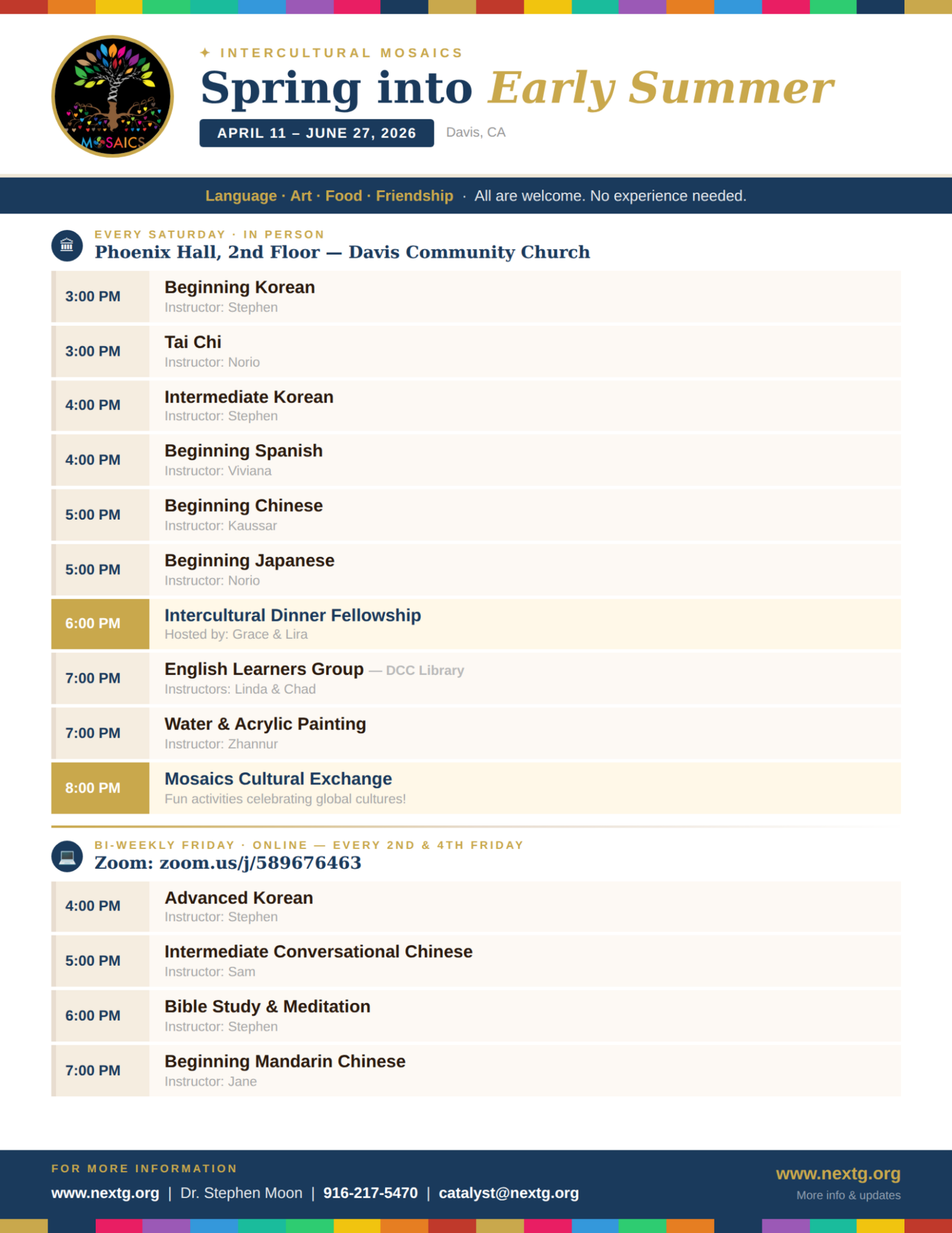
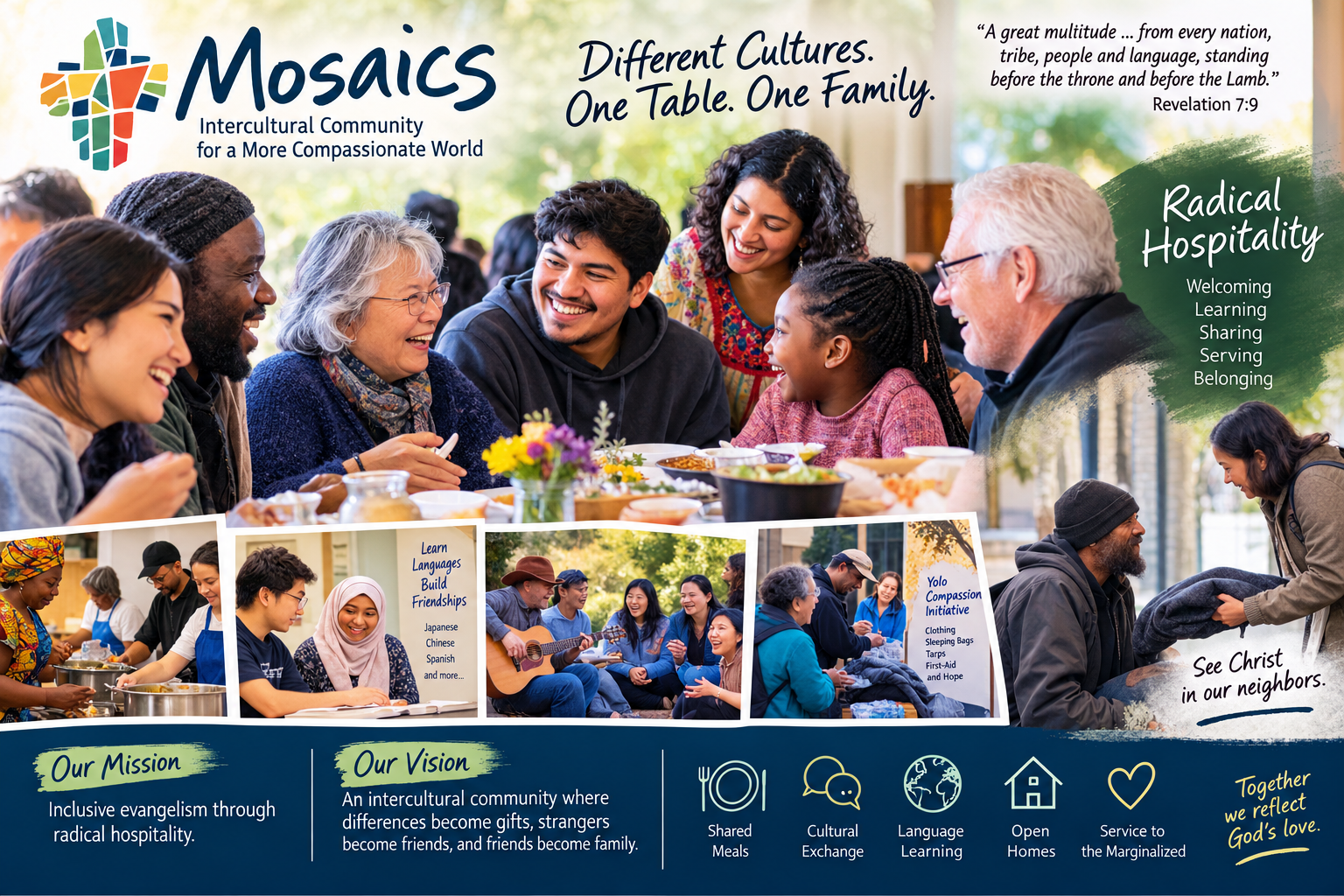
Intercultural Mosaics is a New Worshiping Community hosted by Davis Community Church. We started with a simple belief: a meal can become communion, friendship can become ministry, and ordinary hospitality can become mission.
Every Saturday, people from many cultures, languages and generations come together. We eat, talk and learn. We study Japanese, Chinese and Spanish, and we cook, play music and make art. Sometimes 50, 60 or even 70 people are there. But the number isn’t what matters to me. What matters are the quiet moments. A Korean grandmother sharing her food with a young Latino family. An international student practicing English with a neighbor. A newcomer who came alone and finds people who remember her name.
One of our regulars is a man who is homeless. He first came for the Saturday dinner, and now he joins our English class too. I won’t tell his story here, because it’s his to tell. But he is no longer someone we help on the side. He comes to eat, he comes to learn, and he is part of the room.
That is what I mean by radical hospitality. It means opening our lives, and not only the church door.
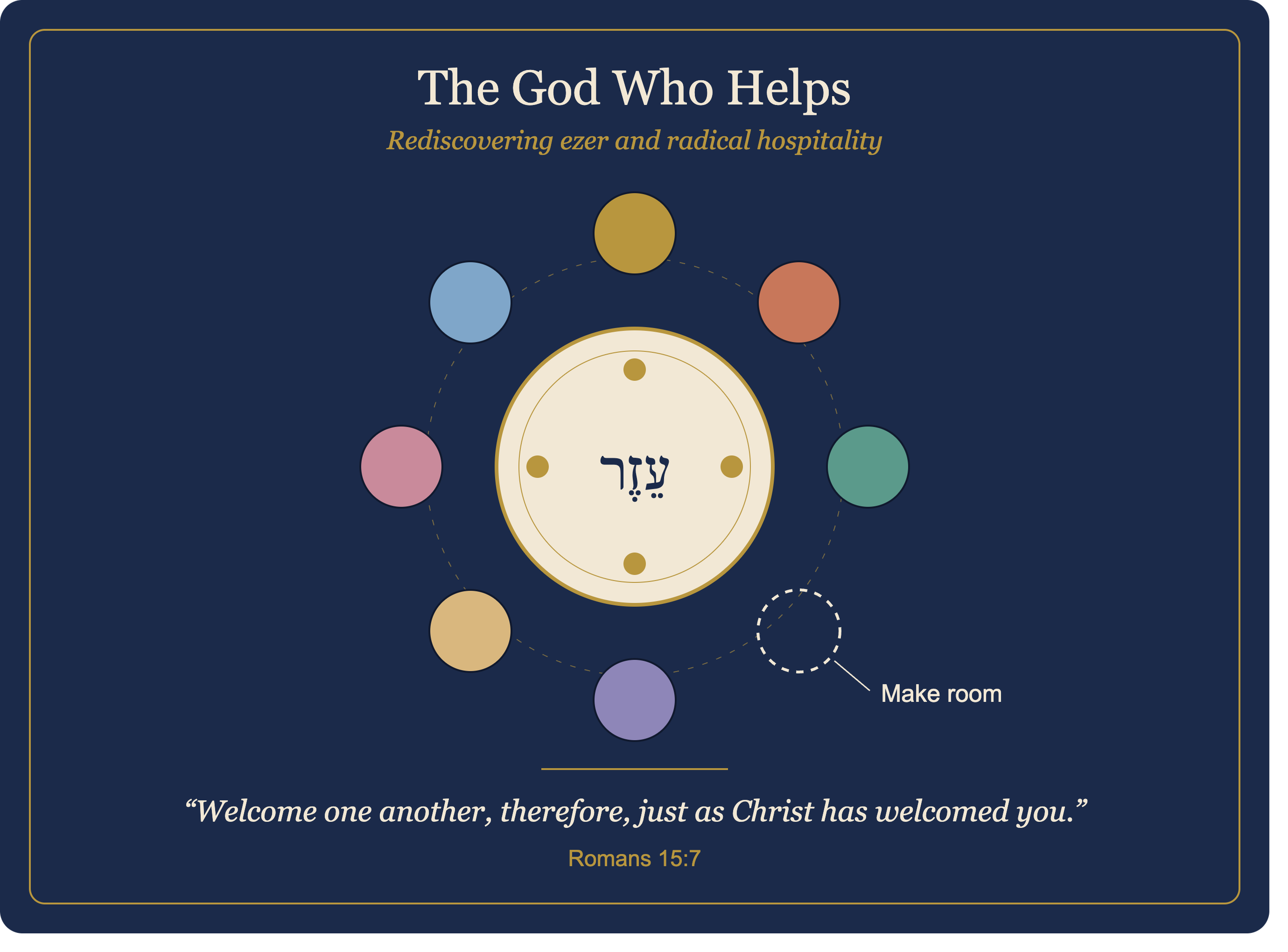
Jesus knew the power of a table. He ate with tax collectors. He crossed boundaries to meet Samaritans. In Acts 2, the early church “broke bread in their homes and ate together with glad and sincere hearts” (Acts 2:46). A meal doesn’t ask anyone to agree, or to come from the same place. It just says, “There is room for you here.” Sometimes the most missional thing a church can do is set one more place at the table.
Seeing Our Neighbors
Crossing boundaries is about more than ethnicity and language. It also means crossing the lines of income, housing and education. Through our Yolo Compassion Initiative, we walk with unhoused and under-resourced neighbors in Yolo County. We hand out clothing, sleeping bags, tarps, first-aid supplies and flashlights. Those things matter, but the deeper ministry is relationship.
A person living outside can so easily become invisible. People see the tent and miss the person. They see poverty and miss dignity. I want us to see a child of God, someone’s family member, a person with a story. When we offer a meal or a sleeping bag, we hope to offer friendship and hope along with it, so that people know they are seen and valued, and that they belong in God’s community.
Peter Had to Cross the Threshold
In Acts 10, God sends Peter to the house of Cornelius, a Gentile. Peter had to step over a threshold he would have avoided before. He listened, and he found that God was already at work among people he had thought of as outsiders. “I now realize how true it is that God does not show favoritism,” he said (Acts 10:34). It wasn’t a new worship style that changed Peter. It was going into another person’s home.
We Don’t Have to Give Up Who We Are
I know some leaders of long-established congregations worry about this. Do we have to give up who we are? No. Nobody is asking you to erase your history, your hymns or your traditions. Paul writes that “you are all one in Christ Jesus” (Galatians 3:28), and he doesn’t mean we all become the same. Your church can stay itself and still grow more curious and welcoming. Ask how who you are can become a blessing to the people God is bringing into your life.
Start Small
You don’t need a big new initiative. Meet someone different from you and become a real friend. Invite someone to your table, especially someone from another culture or economic background. Ask about their story and listen, without trying to fix anything. Go visit a community where you are not the majority, as a guest and a learner. Open your home. And then do it again, and again.
Many of our churches now sit in neighborhoods that have changed a great deal. There are immigrants, international students, refugees and multilingual families nearby. That can feel threatening to some of us. I would like us to hear it as an invitation. Maybe the mission field is the apartment next door, or the person sitting next to us on the bus. The question is whether we will notice, and cross the street.
My Hope for Our Churches
I dream of Presbyterian churches where intercultural life isn’t limited to one Sunday a year, and where the pastor isn’t left to carry it alone. I dream of members who have friends from many cultures, and homes that are open. I dream of children who grow up thinking it’s normal to have a friend who speaks another language, and of older members who find that newcomers have a lot to teach them. And I dream of people experiencing homelessness being known as neighbors, and not treated as problems.
A committee can’t build a church like that. It grows slowly, through a meal, a friendship, a conversation, an invitation, one open door at a time.
Jesus didn’t tell us to make people like ourselves. He told us to make disciples of all nations, and the nations are already here. Maybe the next chapter of our mission starts when we stop waiting for people to come through our doors and start walking through theirs.
May God give us courage to cross thresholds, enlarge our tables, and open our eyes to the people our society overlooks.
Grace and peace,
Stephen